Trade Show Photo Collection Strategies That Work in 2026
Discover effective trade show photo collection strategies that capture every moment, boost engagement, and maximize your event ROI. Learn proven techniques now.
By Guest Clicks Team · · 13 min read

You've spent months planning your trade show presence—perfecting your pitch, designing an eye-catching booth, and training your sales team. But here's what most exhibitors miss: while you're busy scanning badges and handing out brochures, your attendees are capturing hundreds of authentic moments that could be powering your marketing for months. In 2026, the savviest trade show exhibitors aren't just collecting business cards; they're collecting visual stories that transform three-day events into quarter-long marketing campaigns. Let's explore how strategic photo collection can become your competitive advantage on the expo floor.
Why Trade Show Photo Collection Is Your Most Underutilized Marketing Asset
Walk any trade show floor and you'll notice something fascinating—nearly every attendee has their phone out, documenting demos, snapping selfies with team members, and capturing product details. Research shows that trade show attendees take an average of 47 photos per event, yet most exhibitors capture less than 10% of this content. That's a massive missed opportunity sitting right in your booth.
The power of user-generated content (UGC) from trade shows can't be overstated. In B2B marketing, UGC generates nearly 7 times higher engagement than polished brand-produced content. Why? Because prospects trust peers more than marketing departments. When a potential customer sees another professional genuinely excited about your product in an authentic photo, it carries weight that no brochure can match.
Photos also solve the eternal trade show dilemma: how to extend your event lifespan beyond the final day. Without visual content, your trade show investment evaporates when the hall lights dim. But with strategic photo collection, those three days of activity fuel social media campaigns, email nurture sequences, and sales materials for three months or more. Every attendee photo becomes a miniature billboard for your brand, circulating through LinkedIn feeds and Slack channels long after you've packed up your booth.
Companies that implement strategic photo collection at trade shows see an average 312% increase in post-event social media engagement and a 47% reduction in content production costs.
Consider the SaaS company that recently exhibited at a major tech conference. By implementing a systematic approach to photo collection using QR codes placed throughout their booth, they gathered 847 attendee photos. Those images generated over 12,000 social impressions and directly contributed to 34 qualified leads—simply from people sharing their own photos. A manufacturing exhibitor took it further by incorporating booth visitor photos into their follow-up emails, achieving 41% open rates compared to the industry average of 18%.
The authentic social proof created by attendee photos resonates with prospects in ways that professional photography alone cannot match. When you combine both—professional shots for polish and attendee photos for authenticity—you create a content ecosystem that covers every stage of the buyer's journey.
The QR Code Revolution: Frictionless Photo Collection at Scale
If you've ever asked trade show attendees to download an app to share photos, you've witnessed the immediate drop in enthusiasm. In the bustling environment of a convention center, friction is the enemy of participation. This is where QR code-based solutions have fundamentally changed the game in 2026.
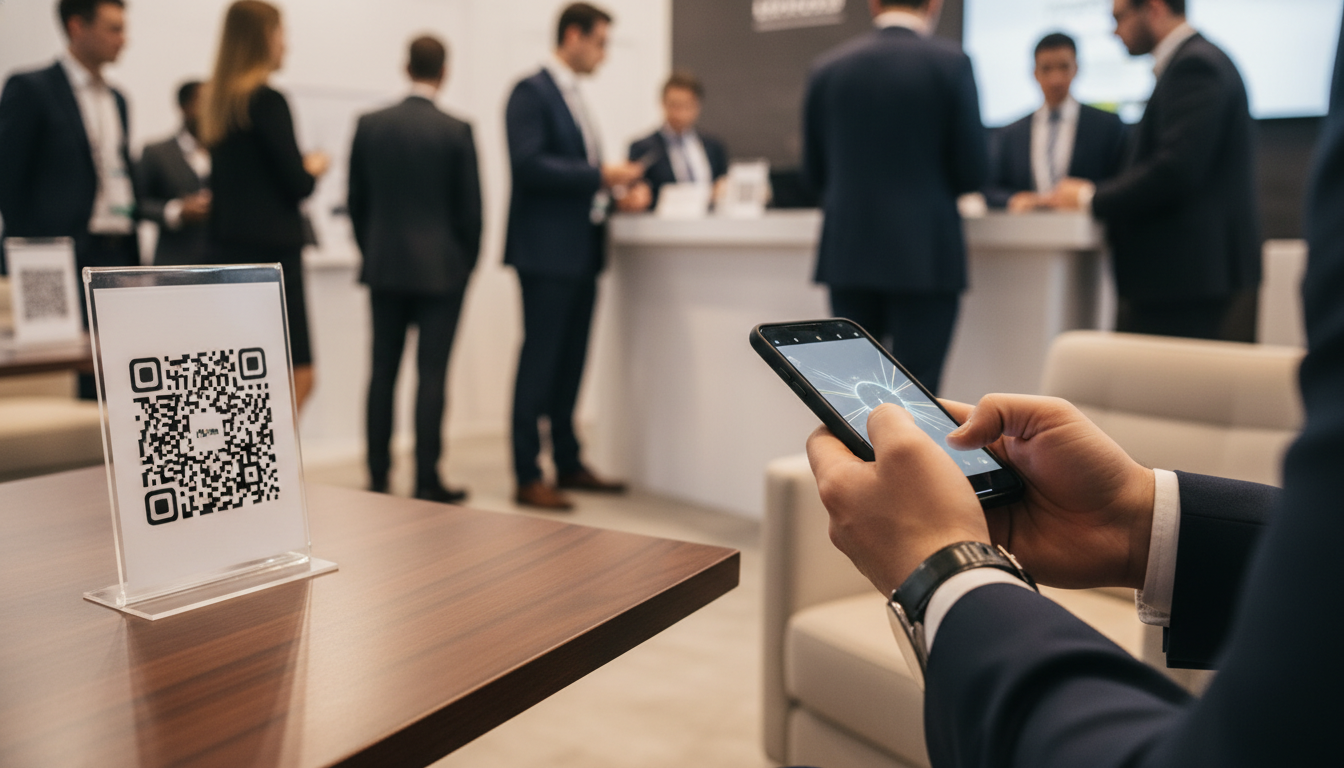
QR code scanning eliminates the single biggest barrier to photo sharing: app downloads. When attendees must download yet another application to participate, approximately 78% abandon the process before uploading a single image. Browser-based QR code systems sidestep this entirely—guests simply scan, open their native camera or browser, and upload instantly. No storage concerns, no compatibility issues, no forgotten passwords.
The strategic placement of QR codes creates multiple touchpoints for engagement throughout your booth. Table tents at demo stations allow prospects to instantly share product interaction photos. Branded swag items with printed QR codes extend photo collection beyond your booth footprint and throughout the venue. Badge inserts, vertical banners, and even floor decals can all become photo collection portals.
QR code-based photo sharing has a 78% higher adoption rate than app-based solutions at trade shows because it eliminates the single biggest barrier: asking busy attendees to download yet another app.
Real-time gallery viewing adds another layer of engagement. When attendees can immediately see their photos alongside others in a live gallery, it creates a snowball effect of participation. The social proof of seeing peers engage encourages others to join in, and the FOMO generated among non-attendees who view the gallery online extends your reach far beyond the convention hall.
Solutions like Guest Clicks have made this process seamless, allowing exhibitors to generate custom QR codes that work in any mobile browser. The key is ensuring your chosen platform requires no app download and offers instant upload capabilities—anything less creates friction that kills participation in the fast-paced trade show environment.
📸 Collect Every Guest Photo at Your Next Event
Stop chasing guests for photos. With Guest Clicks, you create a QR code, guests scan and upload — it's that simple. No app downloads, no hassle.
Strategic Booth Design for Maximum Photo Engagement
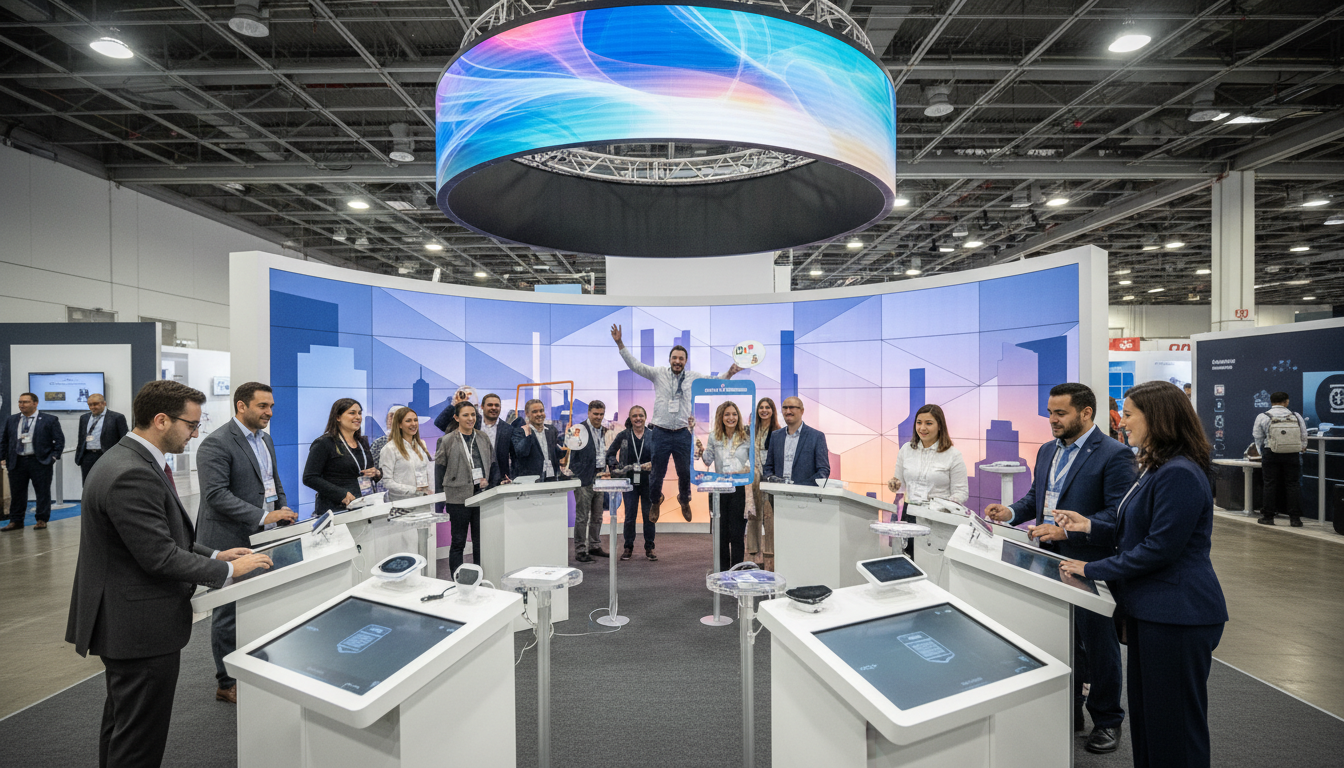
Effective photo collection starts with creating moments worth capturing. Instagram-worthy photo opportunities don't just increase your content library—they drive booth traffic by 40-60% and create natural conversation starters for your sales team. In 2026, booth design must balance aesthetic appeal with photographic functionality.
Start with your backdrop. Branded step-and-repeat walls are classic for a reason, but consider interactive displays that incorporate your product naturally. A software company might feature a large screen displaying their dashboard with a cutout where attendees can pose "inside" the interface. A hardware manufacturer could create a scaled-up version of their product for photo opportunities. The key is ensuring your branding is visible but not overwhelming—attendees should want to share these photos because they look good, not because they feel like advertisements.
Lighting considerations are crucial for smartphone photography, which accounts for nearly all trade show photos. Harsh overhead expo hall lighting creates unflattering shadows and washed-out product shots. Instead, incorporate soft fill lighting around demo stations and photo areas. LED panel lights with diffusers ensure faces look natural and product details remain visible without professional camera equipment.
Signage plays a surprisingly important role in participation rates. Clear, simple instructions explaining the photo-sharing process can increase participation from 12% to 47%. Your signage should answer three questions: Why should I take a photo? (Create FOMO or offer value), How do I share it? (Show the QR code prominently), and What happens next? (Mention the live gallery or contest).
Design specific zones within your booth for different types of photos. A product demonstration area with optimal lighting and branded backdrop encourages "before and after" documentation. An interactive experience—whether AR displays, hands-on demos, or simple photo booth moments—gives attendees a reason to reach for their phones naturally. When planning your corporate event strategy, consider how each square foot of your booth can generate visual content.
Moderating and Organizing Trade Show Photos for Business Impact
Collecting hundreds of photos is only valuable if you can transform them into usable assets. Raw photo dumps create chaos; organized, moderated galleries create marketing gold. The key is implementing systems that maintain authenticity while ensuring brand safety.
Real-time moderation prevents inappropriate content while preserving the genuine feel of user-generated material. Modern platforms allow you to review uploads from your phone as they come in, approving appropriate content within seconds. Interestingly, you should aim to approve 95% or more of uploads—over-moderation kills the authentic vibe that makes UGC effective, while under-moderation risks brand damage. Most attendee photos at professional trade shows are entirely appropriate, requiring only quick quality checks.
Tagging and categorizing photos by product line, attendee type, or session enables sophisticated follow-up campaigns. When you can identify that a particular prospect uploaded three photos of your new software feature, your sales team can follow up with relevant case studies rather than generic brochures. This level of personalization was impossible with traditional trade show lead capture but is straightforward with modern photo collection apps with moderation tools.
Create curated galleries for different internal audiences. Your sales team needs photos that show prospect engagement and product interest. Your marketing department needs high-quality images for social campaigns. Your customer success team needs testimonials and interaction shots. By organizing photos into these categories immediately during the event, you streamline post-show workflows and ensure each department gets exactly what they need.
Consider creating VIP galleries for executive attendees and key prospects. These private collections can become part of personalized outreach—imagine sending a follow-up email that says, "We loved having you at our booth. Here are the photos from your demo with our CEO." This level of attention to detail distinguishes your brand in crowded markets.

Converting Trade Show Photos Into Lead Generation Machines
The true ROI of trade show photo collection emerges in your follow-up strategy. Photos provide context that business cards lack, creating opportunities for highly personalized outreach that converts at rates traditional methods can't touch.
Photo-triggered email sequences achieve 3-4 times higher engagement than standard post-event follow-up. When you send a prospect an email featuring their own photo from your booth—perhaps showing them interacting with your product or posing with your team—you create instant recognition and emotional connection. The email feels personal rather than automated, even when sent through your marketing automation platform.
Social media amplification extends your reach exponentially. Encourage attendees to share their photos with branded hashtags by making the sharing process effortless and rewarding. Consider running a "best photo" contest post-event to maintain engagement for 2-3 weeks after the show. This keeps your brand in prospects' feeds during the crucial decision-making period when they're evaluating vendors.
Integration with your CRM transforms photo data into actionable intelligence. When you connect photo engagement metrics—who uploaded photos, which gallery images they viewed, how long they spent in your photo collection—with your sales pipeline, you identify highly engaged prospects. Someone who uploaded five photos and viewed the gallery twice is signaling serious interest, even if they didn't stop by your lead scanner. For more on maximizing these metrics, explore how corporate event ROI correlates with photo engagement.
The best trade show exhibitors don't just collect photos—they create photo-worthy experiences that attendees want to share, turning every upload into a mini-advertisement for their brand.
Use collected photos to create compelling post-event content. Recap videos featuring attendee perspectives, blog posts showcasing real user interactions, and social campaigns highlighting authentic moments all perform better than polished corporate communications. One manufacturing company reported that their post-event content featuring attendee photos generated 3x more demo requests than their standard product-focused materials.
Measuring Success: KPIs That Matter for Trade Show Photo Strategies
Like any marketing initiative, your photo collection strategy needs measurement frameworks to prove value and guide optimization. Move beyond vanity metrics to track indicators that correlate with business outcomes.
Participation rate—photos uploaded per booth visitor—serves as your primary engagement metric. Industry benchmarks suggest that 30-50% participation is excellent, 15-30% is good, and below 15% indicates process friction or poor promotion. Track this daily during multi-day events so you can adjust signage or staff behavior in real-time.
Social amplification metrics reveal your extended reach. Monitor shares, tags, and hashtag usage to understand how attendee photos are spreading beyond the convention hall. Calculate your earned media value by estimating what you would have paid for equivalent reach through paid advertising.
Most importantly, measure lead quality correlation. Track whether prospects who engaged with your photo collection convert at higher rates than those who didn't. Many exhibitors find that photo engagement correlates strongly with sales-qualified opportunities—attendees who take the time to document their experience are typically more invested in your solution.
Content ROI calculations should factor in production cost savings. When you have 500 attendee photos from a trade show, how much do you save on stock photography and professional shoots for the next quarter? One enterprise software company calculated that their corporate event photo strategy reduced their content production budget by 40% while increasing engagement.
Finally, track which photo types correlate with qualified opportunities. Do product demo photos indicate higher intent than booth selfies? Do group shots with your sales team lead to faster closes? This intelligence helps you design better photo opportunities at future events.
Frequently Asked Questions
How many photos should I expect to collect at a trade show?
With an effective QR code strategy, expect 30-50% of booth visitors to upload 1-3 photos each. For a booth with 200 meaningful interactions, that translates to 60-100 visitors uploading 120-250 photos. High-engagement booths with interactive experiences can achieve even higher rates.
What's the best way to encourage attendees to upload photos at trade shows?
Combine three elements: create genuinely photo-worthy moments (interactive demos, branded backdrops), make the process frictionless with QR codes requiring no app download, and have enthusiastic staff who actively encourage participation during natural conversation breaks. Clear signage explaining the process is also essential.
Should I use a photographer or rely on attendee photos at trade shows?
Do both strategically. Professional photographers capture polished brand imagery and key moments you control, while attendee photos provide authentic social proof and user-generated content with higher engagement rates. The combination gives you diverse content for different marketing purposes.
How do I prevent inappropriate photos from being uploaded at my trade show booth?
Use a platform with real-time moderation capabilities that lets you review and approve photos before they appear in the public gallery. Most systems allow you to moderate from your phone, and in practice, 95%+ of uploads are appropriate—quick moderation maintains authenticity while protecting your brand.
Can I integrate trade show photo collection with my CRM system?
Yes, many modern photo-sharing platforms offer integration capabilities or export features that let you connect photo engagement data with your CRM. This allows you to identify highly engaged prospects based on photo uploads and gallery views, triggering personalized follow-up sequences.